Sunday, December 21, 2008

Gender Roles

(Note:  This is just what I have observed, not necessarily what I believe, endorse or judge.  Any angry remarks can be promptly shoved up your ass.)


I once read an article about a Polish monk who was offering sexual advice to couples.  He said that most of Poland's problems stem, not from communism, but from chauvinism.  While women are by no means second-class citizens, I have noticed a distinct difference in people's views on gender roles.

Some of my students are well educated, have been to more places in the US than I have, hold well-paying jobs, and consider themselves modern.  Yet they still firmly believe in the traditional roles of men and women.  Men are supposed to hold the jobs and support the family, women are supposed to cook, clean and raise the children.  One memorably said, "For a girlfriend, it's better to date the pretty, thin girl, but for a wife, it's better to have to woman who can clean, cook, looks OK."  Clearly this is almost the opposite of the New American Wife.  Women are expected to cook anymore, and finding one that can cook well s considered a snag (only if she's got the personality and the look.)  I asked a student what the price of milk was in Poland, he replied, "I don't really know.  My wife does the shopping."

Pan Rothstein, my former Polish professor, remarked how marriages between American men and Polish women tended to work out, while marriages between Polish men and American women were doomed to fail.  American women are more independent.  Many don't want children, can't cook worth shit and aren't really bound to tradition.  This mindset is contra to the traditional Polish mindset and so friction can get quite high.

I was lectured on my poor manners when I failed to hold doors open for women.  I tried to explain that in the US, most men don't do this.  In fact, it can get you yelled at.  While it used to be a simple gesture, now it's taken on a symbol of male superiority for some reader.  Women don't like to be thought of as weaker (hey, it's no skin off my ass.  I get first dibs into the door and I don't have to be polite by holding it open.)

Sunday, December 14, 2008

Auschwitz and Wieliczka

A train ride away from beautiful Krakow lies Oświęcim (Osh-vee-ow-cheem.) I actually went by bus with a tour group. It's a package tour that can be purchased fairly cheaply (I think it was 80zl or something per ticket.) It includes a tour of Auschwitz and Wieliczka, the nearby salt mine. Also, included in it is a walking tour of Krakow, which we chose not to do.
It was a rainy and drizzly day in spring. Very dreary. The bus ride (a van, actually) there was around two hours, with the organizer calling us "my dears." We first went to Auschwitz I, entering a camp of large brick buildings not unlike dormitories (they were barracks first.) There is the "Arbeit Macht Frei" above the gate (Translated mostly as "Work makes you free." But I'm going to add the inevitable dash of extreme pretension and translate it with my rudimentary German as "Work Makes Free" (literal.) Anyway, the basic gist of it is "Work sets you free," "Through work, there is freedom," or "Within work, there is freedom." I think most people have the literal sense that they were trying to tell their captives that if they worked enough, they would be set free; however, I think it's more of how the prisoners should put their everything into work, let it define them, and through that they will spiritually be set free (but not actually set free.)) The tour guide was pretty good and gave us a tour of some of the buildings. The most horrifying exhibit was the hair of 40,000 women. In the same room was a bolt of cloth made from human hair and a Nazi officer's uniform made of the same material. It almost unbelievable to see the hair of 40,000 human beings piled up in a small mountain behind glass.
arbeit macht frei
The notorious slogan. That lady in the middle there annoyed me by always getting in my shots (like this one.)
A barbed wire fence in Auschwitz I

Several tours were going around at the same time as we. The one right in front was a group from (presumably) Israel. Many members were draped with the Israeli flag and took to waving it from windows when they had the chance.
After the tour of Auschwitz I, we went for a break and ate at a small cafeteria. Back on the bus for the tour of Auschwitz II-Birkenau. This tour was less extensive. They showed us two of the buildings, one being the toilets. Then, they let us wander about for a half-hour before we had to leave. We elected to climb the main guard tower above the entrance.
auschwitz
The rain and mud made it even more somber.
Auschwitz

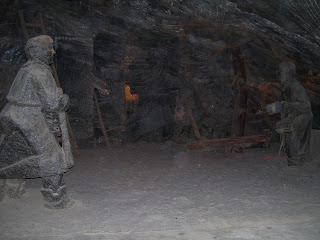
A small group of Americans were left and we went to Wieliczka, home of the salt mine. This place is absolutely beautiful. The mine is defunct, and one might be thinking, "How interesting can a salt mine be?" I agree, salt is not actually the most interesting of compounds (chemists might disagree) and is a very basic seasoning. But there, there are sculptures, small lakes, a restaurant, an entire church, gigantic rooms, chandeliers made from salt crystals, and (this is the best part) you can lick the walls!!! The tour guide showed us on particular sculpture, which looked like it was carved from a normal type of stone (like a dark, dark jade), then stuck her flashlight against the stone to show how the stone was semi-translucent. The air is very nice and supposedly can work wonders for those with pulmonary ailments. It's pretty snazzy.
salt sculpture wieliczka
A salt sculpture (one of many.) In reality the salt is very dark and green. The effect of looking like frost or snow comes from the reflection off the salt crystals from the camera's flash.
wieliczka
A staircase leading ever downwards.

The tour ended, and we headed back to Krakow. Since our van was overflow from the bus and did not have TVs, we couldn't watch the introductory video on our way to Auschwitz. The organizer promised us that we could show up at the tour office the next day for a free DVD, but that was not the case. I think we came back more than a year later and asked for it, but no luck.

Saturday, December 13, 2008

Going Back to Poli

I'm going back to Poli, Poli, Poli.

Anyway, in a week I'll be in Warsaw. I can't wait. There's something about this city… hmmmmm. A lot of Poles don't like it. They mostly admit that it's because Warsaw has all the money and jobs. Apparently all the people there are assholes too (I don't think so.) The way they imagine people from Warszawa is the way we imagine people from New York: arrogant pricks. I didn't really find that to be the truth.
Like most capitals and finacial centers, it's busy, noise and sometimes dirty. It's not really known for its architecture, and all it's old buildings were razed to the ground. In fact, Warsaw is a fairly new city. Most of it dates back to the fifties and sixties. They are throwing up new, large and impressive buildings, but the Palac Kultury i Nauki still dominates the skyline. I actually kind of like that too, even if it does represent Soviet domination.
Places like LA and Detroit and almost all universally reviled for their hideousness and lack of soul. Places like Pheonix and the endless sprawls of elsewhere do nothing for me. In Warszawa, there is something.

I hope to make it to Krakow and any other city I can. Lodz, especially. I also hope to be back teaching, but a little less and not in the schools.

Thursday, December 11, 2008

Trains

Trains in Poland are a mixture of rotting infrastructure and cutting modernism.  Like the I.C.E trains in Germany (I have ridden no better train), a super-fast, modern InterCity zips about with the riders in comfort.  But most, and cheaper, trains stick the old compartment-style car (personally, it's my favorite) with no enforcement on the non-smoking rules and bathrooms that would make any hobo gag.  Riding to Gdynia (a 9 pm train that took five hours) taught me how packed a traincar could get.  Riding back taught me how miserable it can be to travel.  I found a flea that very same day I arrived back in Warszawa.
The trains go most everywhere (not to Kazimierz Dolny) and places the trains don't go, the buses do.  Since there is a lot of construction on the rail lines, it can be faster to take the bus, sometimes several hours quicker.  While most trains are not the most modern, there are not without creature comforts.  The express train to Krakow offers a small snack and a free drink (tea, water, coffee, juice, etc); however, it's only on the way from Warsaw to Krakow and not the other way around.
Warszawa Centralna, to me, is beautiful building.  One of my favorites in Warszawa.  It's imposing, reminiscent of a more communistic time.  It's great, sweeping wings spread out majestically.  Inside is a wide open hall, and underneath is a maze of tunnels leading to the tracks.  It's really quite something.  In the inner hall they even have a crackling intercom system that is just so… rustic.  Most Poles hate it and most agree that it's hideous.  I feel somehow drawn to it.  Walking across that great inner hall always feels like an adventure.  It's flanked by smaller stations which service region trains.  I've never been in them.
Warszawa Centralna
Warszawa Centralna

On occasion, I can get lucky and sit in a empty compartment.  Two benches to choose from, with enough room to mostly lie down.  Other times, I'm stuck with a smoker.  Traveling with different people in a compartment can be tough.  In the summer, someone might close the window when you want to open it, and close it when you want it open (same with the door into the compartment.)  In the winter, it can be worse.  Women having hot flashes have no restraint in lowering the window to cool off, even though you are obviously shivering and suffering from hypothermia.
One good thing is that Poland does not have a high amount of fat people.  You know those fat, hideous excuses for humanity that insist on taking up as much space as they can with their enormous, cellulite-filled asses?  The ones with tits the size television sets and whose every breath sounds like a ratty, old refrigerator's compressor?  Plus the random sounds that only a horse giving birth should make?  Well, there are not a lot of them here, which is actually a great blessing.

Wednesday, December 10, 2008

Updates-Schumpdates

I kind of petered off on the writing.  That's OK.  Mostly it was because I left Poland at the beginning of September, but I'll be returning soon.

In August we went to Sosnowiec, a mining town near Katowice.  It's sizable, but very industrial and I didn't actually see a lot of it.  I hear it's basically just a mining town (think of a European New Jersey.)  The train station was kind of nice.

Besides that, I didn't go very many places outside of Warszawa.  I did explore more of Warszawa, and found some places I never knew existed.  It really is a nice city.

Anyway, I'll be returning to Poland soon, and more tales to come (as well as more updates.)

Saturday, August 2, 2008

Today

I was walking down the street today, and I was struck by how many Polish flags there were. Yesterday too! On the subway, on the buses, from houses and stores...
At first I noticed it when I went to take the bus and it was fluttering Polish flags. Later, in the subway I saw two smaller ones perched on the dashboard by the driver. Exiting the subway I saw a family with two young boys carrying the flags with the PW anchor (Polska Walczaca) as if they had just come back from a trip to the zoo. I thought nothing of it really.
Then I realized that it was August 2nd, and yesterday was the sixty-fourth anniversary of the Warsaw Uprising. It's silly that I forgot about it, because I just read a book called, "Rising '44: The Battle for Warsaw" by Norman Davies. It's pretty good and pretty critical of everyone, the Soviets most of all.
Well, Warsaw, hats off to you
.Old Home Army Soldier
An old soldier who fought it the uprising.

Letters Polish uprising
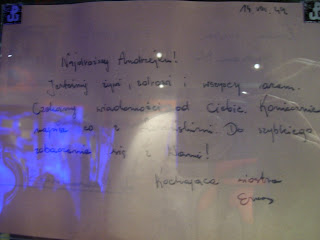
A letter to a young Polish soldier from his sister.

Zakopane

It's pronounced "Zack-o-pahn-eh."
Downtown Zakopane
Downtown Zakopane

It's a small town southwest of Krakow in the Tatra mountains. I was only there in March, where the snow still crested the mountain tops. It's quaint, and the mountains about are quite beautiful. Apparently it's a big vacation escape for skiing, mountaineering and just plain visiting.
One can ascend one of the mountains (hill, more like it) by a small tram elevator. In Fribourg they have one just like, except that one uses waste water for power.
At the top there's a view of more mountains, particularly of one called "The Sleeping Knight." I wouldn't suggest more than an afternoon here, but it's worth the two-hour bus ride from Krakow. The bus also stops in places like Nowy Sacz.
A view of the Tatras

Thursday, July 31, 2008

Students Redux

Tomasz greeted me yesterday in boxers and socks, but at least he had on a different shirt. He still says some of the most crude things I've ever heard, but this time it was not about the sexual things.

Franio, oh Franio. My three-year old student has left me. Just as well. Want to know how stupid I felt prancing about to kids' songs with a cat puppet on my hand? The answer is, "very."

I was overjoyed that I was able to tell a joke to my students. At the "Speak and Spell" school, I was holding classes with Julita, 23, Barbara, 40-50 or older, and Elizebeta, age not known. Julita speaks English the best, and we were talking about names and naming children. Ben King had told me a good joke, so I used it: A baby indian asks his father, "Where do children get their names?" And the father says, "Well, when a child is born the father takes it and walks outside the teepee and the first thing he sees becomes the child's name. Why do you ask, Two Dogs Fucking?" Julita got it and laughed, but the other two women thought long and hard going over each word. They finally didn't get it. Their loss.
The other student at that school, Martyna (three Martyna students in one summer) probably has some of the greatest potential I have ever seen. She is thirteen and has learned English for three years, but has a wide vocabulary, understanding of grammar, and most of all, can tell the difference between bad and bread, dad and dead, sad and said, etc. She knows about the long "th" and short "th" (wiTHer versus wiTH) but like the other student, Tosia, she doesn't seem like she wants to apply herself. It is a shame.

Skin Market

Over the weekend I went to the Baltic coast, to a tiny village called Gdynia. Little more than a gathering of ramshackle huts, it is still a nice place to get away from it all and join the many thousands of tourists that throng the beaches for miles.
The Tricity (Trojmiasto) consists of Gdynia, Sopot and Gdansk. Perched in the middle of Poland's Baltic coast, it's often a vacation spot for those who don't go to Greece, Spain, Turkey, Bulgaria or Croatia. A tiny peninsula, Hel (yes, pronounced like "Hell,") juts out and curves around like a little, feeble arm trying to give the rest of Poland a hug.

The Stare Miasto of Gdansk

I finished up my last lessons on Friday and took the 9:45 pm train for five and half hours. I had figured that with such a late train the wagons would be next to empty. Wrong. I was able to get a seat in a crowded cabin, and I was quite lucky since there were many more people stuck in the corridor. I sat between a guy in his twenties who spent a great deal of time looking at a porno mag that also had guns and weapons in it. Kind of like a "Chicks with Dicks" but instead of dicks there were articles on sniper rifles and heavy machine guns. The other guy next to me was about seventy, had bad breath and tried to make conversation with me in broken English. Between my broken Polish and his broken English we eked out a small conversation. He was joining his wife and son in some other town (I forget which,) he said he had lived in the US and was into Mathematics. He sometimes asked strange questions like, "What do you believe?" and if I understood when John Paul II spoke in Polish. I replied that I had never heard JPII speak in Polish, and maybe that made him think that I was a bad Catholic.
The train was very, very hot and I arrived in Gdynia around 3:15 am. Taking a taxi (which was overpriced) to my friend's house I arrived at around 3:30 or something. Bed time.
On the way back, it was worse. The train, which was the 11:25 pm train, was full before even getting to the station. I was forced into the corridor, right by the bathrooms. Most of the time was spent crouched in a two-foot wide corridor trying to balance and find a place for my camera bag. To my left a guy passed out and laid dowd, blocking the entire floor, and to my right a couple pretty much did the same. People going to the bathroom had to pass over all of us, but since I was "in that spot" where they didn't want to trample the couple and didn't want to trample the guy snoozing on the floor, I had to get up every time a person passed. The girl from the couple kicked me in the head once, talked loudly and smoked. Five-and-a-half sleepless hours on this disgusting floor. Katarzyna said it would be "an experience." Meeting the Pope is an experience; Flying on the Concorde is an experience; getting a blowjob from the Queen is an experience. This was hell.
What is there to do in Gdynia? Well, there's the beach. There's also a pleasant wood which has paths through out it, as it towers on eroding cliffs above the sea. It was so hot, so very, very hot.
One can walk on the beach from Gdynia all the way to Gdansk if you have the stamina. The water is greener than the water on MDI, and has more sea plants in it. Not really seaweed like kelp or bladderwrack, but more of the "matted hair" variety with some grassy looking thing. In places it turned the water into a "spinach soup" as Katarzyna and her friend, Agata, put it. I described it as an oil spill.
The next day we took the ferry to the Hel peninsula to a town called Jarnista or something. At the pier there was a naval band or something, with cheerleaders!!! How cute!! The band played and the cheerleaders had red and white pom-poms are did a whole routine with them. How precious. Going to the far side of the peninsula, we ended up on the Baltic sea on yet another endless beach full of people. Here the water is quite shallow and really clean. No seaweed or anything like that. The water might be a bit cooler (so I was told) and maybe bigger waves, but it was fine. The sand on these beaches is not like the sand on Sand Beach, which is made up of crushed shells. Here, it seems to be more salts, which is OK since the shells of Sand Beach stick to your skin and are more sharp-edged.
Two days in the sun on a fair beach, not bad.

The beach on Hel

Thursday, July 24, 2008

Lodz

Łódź (Woodge), which means "Boat" in Polish, is located in central Poland. Most people don't really think of it as a beautiful city. Factories ruled there. Huge garment factories, when Poland was the Southeast Asia of the world. There are not any royal palaces or gigantic castles with majestic overlooks. There are tons of brick buildings which were once used to exploit the limitless peasantry that inhabited the area.
David Lynch is said to have a fond love for the city. He even bought a defunct power plant (in which I actually spent the night.)
An inhabitant has called it, "The City of Sex and Business," but I found this to not really be the case.  Apparently it has quite a lot of business, but it is still dwarfed by Warszawa.

Of the two times I've been there, I've been to the decrepit power station and to several museums.  One was the old concentration camp.  Much smaller than most would think of, it used to be an old factory.  Another was called the White Factory, part art museum and part factory model where they display machines used in the textile business.  An old palace built by a textile baron was very interesting.