Wednesday, December 31, 2008

Products in Poland

Poland used to be the Southeast Asia of Europe in the 19th century. Lodz used to be the center of the textile manufacturing business, and many of its old factories still remain today. These days the factories are mostly museums or shopping malls. The whirring of looms, clanking of gears, and the blood-curdling cries of peasant workers that have lost limbs in the horrific working environment have all fallen silent, but Poland does churn out some very nice things.

Vodka:
My personal favorite is Wyborowa (Polish for exquisite). It's easily consumed (Bud Light doesn't have shit on Wyborowa's drinkability!) My other favorite is Zubrowka, which derives its name from a type of grass, which in turn is the favorite of the Zubr Bison. In each bottle of Zubrowka, there is a single blade of the Zubrowka. The vodka itself has a slightly woody taste and is a pale yellowish-green.
If you are a fan of James Bond, you ought to know that Mr. Bond only drinks Polish or Russian Vodkas (he's been lately pandering for Smirnoff, which kind of sucks.)

Pottery:
Polish pottery is wonderfully beautiful. It's all very rustic, with intricate-yet-simplistic painted designs. Useful, sturdy and versatile, it's a wonder why it's not more popular in kitchens and dinner tables. There are several sets of designs, each just as incredible as the next. It is actually not that expensive either (some sets are more intricate, hence more expensive.) A three-quart pitcher is usually around $20 (at the going exchange rate. Last summer it would have been around $30.)
Polish Pottery
Tea pots and cups in a shop.
Polish Pottery
Gorgeous cookware and vases.

Koniaków:
Koniaków lace may not be as well known as that of Burano, but it does grace the tabletops of the Pope and the Queen. In recent years, the younger generation has decided to be more innovative in their products and have begun making lingerie and some women's wear. This lingerie is the SEXIEST stuff I have ever seen. Victoria's Secret could learn a thing or two.
http://www.koniakow.com/ is the website and online store. (http://www.koniartusa.com/ and http://www.koniakowusa.com/ are the US versions) It's quite expensive (then again, what isn't in the world of fashion?)

Coffee:
Actually, Poland doesn't have good coffee. I must say, most of the stuff you get in the stores is total shit. 80% of the coffee for sale is instant coffee and some of that is made of chicory (Lord save us!!!) They do have some very nice coffee houses, which serve good coffee.

Chocolate:
The Swiss and Belgians have traditionally owned this field, and rightfully so. Polish chocolate is quite good, and I like it a lot.

Pierogi

Pierogi are the plural of 'pieróg' (dumpling.)  In the US, we say "pierogis", which is technically incorrect because we're doubling the plural.  In Poland, one can see on the store windows ads for "chipsy."  No joke.  They're doubling the plural for chips in adding a 'y'.

Here's what I do for pierogi dough.  I make it via approximate amounts, so there are no clearly defined measurements.  Sometimes it needs a little more water, sometimes it needs a little less.  That type of thing (get the idea?)

5.000 cups of flour
Water
Two dashes of salt
Milk product, e.g. milk, yogurt, kefir (this is optional.)
1 egg (optional)

Mix all ingredients into a bowl and knead together until it forms a soft, pliable dough.  Don't make it too elastic.  Add more water to the dough until the consistency feels right.  Roll out on floured surface and use a sizable glass to cut circular pieces out.  Put filling on one side and fold over other side to form a crescent shaped dumpling.  Press edges together until they are sealed (some people dip their fingers into a cup of water and run it around the edge to create a better seal but I don't think it works that well.  It usually just gets kind of messy.)  Put uncooked pierogi into pot of boiling water and remove when floating (about five minutes.)
Can sauté afterward if desired.

See?  It's pretty vague, but that's pretty much how to make pierogi.  Fillings include mashed potatoes and cheese, saurkraut, sweet cheese, meat, anything else you'd want to stick in there.
The milk product will make the dough more fragile, but also softer.  Too much kneading will make it rather tough and bread like.

In-process pierogi.

Frying them up

Monday, December 29, 2008

DVDs

Which corporate asshole thought up DVD regions?  And why the fuck can I only change my computer's DVD region five times before it locks in?  I know, I know, it's to prevent piracy, but honestly, you think that they'd have found a better way?  Poland has DVDs in Region 2, whilst the US has DVDs in Region 1, a tad inconvenient.  They're only making a bigger case for torrent downloading.

Saturday, December 27, 2008

$5 Foot-Long

Well, they did it!!!
When I left in the summer, the Metro Warszawskie went from Kabaty to Marymont.  Tonight, I looked up at the map of the line, which had always stood oh-so incomplete and noticed that it went all the way to Mlociny!!!  No way!!  Not only did they complete another stop, they went another five (or something like that.)  (A didn't even notice that it no longer stopped at Marymont.)   Wow.  Now the subway is truly complete; now they can start building a second line.
Warsaw Metro
The completed line.

Ms. Manners

Since my arrival here, I've been making all sorts of faux pas, from going though doors first to lying down on the couch while company was present.

One thing that might come as a surprise (or might not) is using the formal way of speaking.  Polish, as many languages, has a formal and an informal way of speaking.  English just has the all-encompassing "You."  For instance, if I were to ask a question to someone my age, I might say, "Jak sie czujesz?"  (How do you feel?); however, if addressing an elder or someone of rank I would say, "Jak sie Pan czuje?"  (How do you feel? (formal)  Lit: How does Mr. feel?)  This seems fairly simple.  But, what if you're speaking to the mother, whom you know and everyone else just addresses as "Ty" (informal "you")?  Ought I to use "ty" or "Pani?"  Also, since I don't have a firm grasp on the language, using the "Pan/Pani" form is slightly more difficult when asking complicated questions.  It's kind of the same as in German, but they just have the Sie form which makes everything easier (even easier than the informal way.)

A friend of A's lives in The States and has remarked how he never opens doors for women because they might get offended.  I've grown up with this fact and it has come back to be a major source of friction.  The women here see it as expected and that if a man does not do it, he's horribly rude.  On the other end, I was taught to wait until everyone at the table was seated to begin eating (especially at large dinners such as Christmas and Thanksgiving.)  At Christmas Dinner, I waited a full ten minutes for A, who was out walking the dog.  In the meantime, her entire family has cleared their plates and had started on seconds, all the while urging me to eat.
Another this is that half the table left to watch Harry Potter on TV.
While it's taboo to go through the door before the woman, it's perfectly acceptable to claim that her place is in the home taking care of the children.  (See a previous post.)

Some things span cultures: picking your nose and/or urinating in public, calling a woman fat, refusing to shake hands, etc.

Thursday, December 25, 2008

Christmas Food

Christmastime means good, hearty Polish cooking.
Polish Christmas Dinner
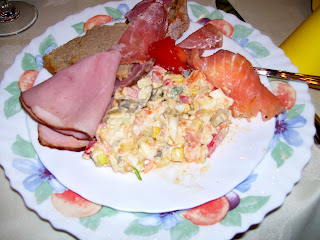
My plateful of appetizers, including: smoked salmon filled with cream cheese and herbs, a salad (kind of like a potato salad without the potatoes), cold cuts (mostly being ham and pork, but also some kindziuk, a Lithuanian cured sausage similar to salami) and bread.

As I stated before, Christmas Eve is devoid of meat and almost every dish contains at least some part fish. Barszcz and pierogi are also main features to the meal. Usually, the barszcz is served with small, pierogi-like dumplings filled with mushrooms. They're called uszka (little ears) because of the way they look. This Christmas we didn't have the uszki, just the barszcz served in glasses like a drink; although, we did have pierogi.
hard-boiled egg caviar
An appetizer I didn't have, hard-boiled egg with caviar. Usually a lemon is squeezed over it.

Herring is the most common fish in Poland. It's called Śledź (shledge) and is a staple of Polish cuisine. If it's not herring, the fish is always something similar, i.e. it's always a whitefish. In the US we think of whitefish as trash fish and mostly used for soups and stews (or making fish 'n chips.) Salmon, swordfish, tuna, trout, these are the fishes we enjoy the most. Fish with high fat content and distinct flavor. Fish that looks good on the plate, and not like some sort of maxipad that's been run under a tap for fifteen minutes.
Anyway, on Christmas Eve we had: herring in oil with onions, herring in some sort of jelly (I didn't try it), herring chopped up in a small side salad, greek-style fish (burbot was used instead of herrring.)
The coolest tradition, I think, is buying a large, live carp; taking it home and putting it in your bathtub; killing, gutting, cooking and serving it on Christmas Eve. Not very many people do that these days, but it used to be popular.
Polish Christmas Dinner
Christmas Dinner: Main Course. Pork loin, carrot salad, mashed potatoes and a salad with oranges. The sauces to the left are horseradish, beet and horseradish and a cranberry sauce.

As for drinks, we didn't have much in the way of alcohol. Two bottles on Christmas was enough for the whole holiday. The white was OK, but the red was dreadful (it was a Spanish red and tasted kind of like transmission fluid.) At both meals the main drink was Coke. Juice and water were also available. On Christmas Eve, we were served a compote made from dried fruit. It came in two versions, one was sweetened and the other was not. Both tasted kind heavily of prunes, but it was OK.

Christmas Traditions

Christmas is kind of big, so I'll cover it in a couple parts.  This year, it was not a white Christmas, but it was cold.

Christmas Eve in Poland is a bigger event than Christmas Day (in terms of traditions.)  It's a day of abstinence from eating meat, and if one is urged to attend Mass; however, not everybody does.  The main festivity of the day is a huge meal, which is mostly composed of fish dishes.  Before the meal we each took a large wafer (akin to the Host one receives in Church except they're big and square and have little pictures pressed into them) and everyone said hello to each other and wished each other health, wealth, good things, happiness, good grades in school, etc.  I mostly just stood there awkwardly and grinned while nodding.  After you wish the other person well, you exchange a small bit of your wafer (you pinch it off the other person's wafer) and each it.  Then, you move on to the next person.  After everyone has wished everyone else well, you all go around the table again.  There was a short, short reading of the Bible, and singing a carol.  I did not burst forth with a melodious rendition, but stood there and listened to verse after verse.  We sat down for the feast finally and began eating.  One curious thing I noticed, is that people here don't wait for others to sit down (or even be at the table or in the room) to begin eating.   For a place where manners are heavily enforced, I found this to be sorely lacking and quite surprising.
During the end of the meal presents were passed out.  It might just be this family, but the gifts were all anonymous and attributed to Santa "Saint Mikolaj."  I received a DVD copy of "Ogniem i Mieczem" (With Fire and Sword), which surprisingly works in my computer's DVD player (so it must be a Region 1 DVD.  I've had problems before with playing other European copies of DVDs.)  I also got a knife set in a handsome wooden case.

On nearly every corner there are Christmas trees for sale.  Most are rather small, which makes sense because most people have apartments.  We opted for one in a pot.  It's been referred to as a "Charlie Brown" tree because it lacks the heavy ornamentation that adorns all other trees.  A string of lights and a handful of bulbs bought from a nearby Tesco are sufficient.  Still, it's the largest of the family.  Other members have fake trees or ones so small they're more like saplings.  My pleas for a traditional method of getting a Choinka were rejected.  I wanted to slog into Kabaty, at night if need be, and chop down a worthy tree.  My mother recently claimed that her tree was the best of all time (a boast I had trouble believing, but that just might be my envy.)  My uncle went to a tree farm and chopped down his own tree (my aunt was not impressed with the one he chose.)    Both my mom and my uncle chopped down large trees and just took the top (an acceptable method.)  Going to a farm is not exactly the same as hunting for that perfect tree, but it's still better than buying one off the street corner.
The tree salesmen nearest to the apartment were way too overpriced.  We had to go one subway stop and got one for half the price: 40zl versus 99zl.  I had to carry the tree on the subway with the top snagging all sorts of places on ceilings (have you ever really noticed how topographical ceilings are?  One doesn't notice it until having to lug a tall object about that scraps against all surfaces under ten feet in height.

Tuesday, December 23, 2008

Kazimierz

Kazimierz is the Jewish Quarter of Krakow. It resides on the northern bank of the Wisla and is adjacent to the Old City. Apparently, it used to by on an island, but part of the river was filled in, connecting it to the rest of Krakow. There are a few museums and sites to see, most notably there are a few synagogues. Only one synagogue is worth a visit, the Old Synagogue, and the rest are pretty mundane. I actually found the place to be quite boring and got lost there several times. The Old Jewish Cemetery is kind of neat, but the new one is even nicer. It's pretty huge, with graves packed in closely together; trees, covered in ivy, tower above.
Old Jewish CemeteryOld Jewish CemeteryOld Jewish Cemetery
There was a museum that displayed old Polish folk art. They had mockups of the interiors of traditional peasant houses as well a large display of traditional Polish dress (quite cute.)

Back to Basics

Well, I'm back in Poland.  The more I travel via bus or plane, the more I despise it.

Poland in winter is the grayest thing ever.  In Warsaw, where most of the buildings are concrete, it's even more so.  Right now the sun is just rising and shining beautifully in my eye, and the clouds are scarce.  It aims to be a beautiful day.


Sunday, December 21, 2008

Museums

Poland is not really renown for its museums.  The city of New York probably has more artwork than the whole country; indeed, the Louvre probably has more (and only displays something like 10% of it's collection at a given time.)  Much of it was either burned or looted during WWII and not everything was recovered.

Krakow boasts a beautiful Leonardo Da Vinci (Lady with Ermine), and used to have a Rembrandt (it went missing in the forties.)  The Sukiennice also held a nice collection of paintings before it was closed for renovations (it won't be open until 2010.)  The Wawel has a very nice collection of Ottoman war treasures that were seized when King Sobieski came to the aid of Vienna in 1683.

The National Museum in Warszawa is worth a visit and is quite sizable.  They have a variety of artwork and historical artifacts, ranging from the ancient Egyptians and Greeks to the early Christians of North Africa.  They also have a good collection of Polish art.  This includes the jewel of the museum (in my opinion) Battle of Grunwald by Jan Matejko.

Kasia in front of Bitwa pod Grunwaldem


One place not to go for museums, is Kazimierz Dolny.  The Museums here are worthless, overpriced (the giant museums of Warszawa and Krakow are cheaper) and have collections that are dwarfed by most high schools.