Showing posts with label Polish food. Show all posts

Tuesday, October 23, 2012

Gratuitous Cold Cuts

It's time to show off some wedliny (cold cuts) and the like.

Tempting


Oh, so meaty and so sinful.

Fish in here too!


A whole table of it!

Kaszanka is actually pretty gross.

Friday, June 17, 2011

Strawberry Time!

One thing I must say about Northern Europe, the produce comes to market far earlier than I am used to.
I come from a place where strawberries are only beginning in mid-June and are full fledged in the beginning of July.  In Poland, strawberries burst onto the scene in late May and early June.  Soon, every peddler on the street is hawking baskets of strawberries upon strawberries.  Cherries will follow in the coming weeks, and I am looking forward to that.
Selling strawberries out of a van.
 A traditional way to prepare the strawberries (besides jams and jellies) is to hull them, cut them, sprinkle them with sugar so they form a tart, sweet, chunky sauce of sorts.  This versatile way of prepping the strawberries allows them to be ladled over nalesniki (crepes) stuffed with cheese, put into fruit smoothies, and mixed with yogurt and cream and eaten with pasta.
Fresh-bought strawberries ready to be washed.

Sunday, June 5, 2011

Recipe: Spicy Pickles (Ostre Ogorki Konserwowe)

While eating lunch at work, I noticed a coworker had sliced spicy pickles.  He offered me a taste, and I found them quite pleasing, and duly asked him for his recipe.  Later, he sent me the recipe his mother uses (who made the pickles), and now I pass it off to you.  Enjoy.


2.5 kg of cucumbers
0.5 kg of sugar
1 cup of water
1 cup of vinegar
8 tablespoons oil
2 tablespoons sweet paprika powder
2 tablespoons hot pepper (cayenne) powder
4 tablespoons salt
1.5 cloves garlic

1) Cut the cucumbers and cover with salt Let stand until water leeches out of the cucumbers. Pour off water.
2) Boil all remaining ingredients.
3) Cut cucumbers, put into a jar(s), pour in marinade mixture, and leave overnight.
4) The next day, screw on the caps to the jars and boil to seal (canning process.)

Sunday, March 27, 2011

Recipe: Paczki

Most people know paczki (singular: Pączek) as a Polish doughnut, jelly doughnut, or as Berliners (pretty much the same thing.)  They are a soft, yeast-dough doughnut, traditionally filled with rose hip jam.
Paczki are imbedded in Polish cuisine like wódka, piernik, and pierogi.  On Fat Thursday (Tłusty Czwartek, the Thursday before Lent.  The French have Mardi Gras and the Poles have Tlusty Czwartek), Poles traditionally eat paczki.  Businesses order them by the bushel for their employees (I alone at five at work and brought another three home.)  The only downside is that Paczki don't keep very well and are best eaten fresh.  You can revive them by sticking them in an oven or microwave, but nothing beats that sinfully soft and chewy dough, mere moments from being pulled from the boiling vat of oil (get it all in before Lent.)

Without much further ado, here's a traditional recipe:

1 kg flour
100 grams yeast
1/2 liter milk (warm)
7 yolks
1 whole egg
3/4 cup sugar
100 grams butter (melted, cooled)
1 jigger (shot) of rum or spirytus (grain alcohol)
Juice of 1 lemon
Pinch of salt

1.5 liters of cooking oil plus 2 spoonfuls of lard
Rose hip confiture (or any other fruit preserve) for the filling
Powdered sugar for dusting (or a mixture of lemon juice and powdered sugar for a glaze.) (Optional)
Candied orange peels (cubed into small pieces) (Optional)

Mix the yeast and 2 teaspoons of sugar and 2-3 teaspoons of flour with a little bit of milk and warm water until it starts foaming.  In a large bowl, beat together the egg and yolks and sugar.  Add in the milk, butter, yeast mixture and then flour.  Mix together and add in lemon juice and alcohol.  Knead for 20 minutes, cover in a bowl and let rise for 30 minutes to an hour.
Punch down the dough.  Place the dough on a floured cutting board and roll it into a thick rope.  Cut the dough into 1.5 cm lengths and roll out into fat pancakes.  Add a spoonful the fruit preserves to the center of every-other pancake. Seal the paczki well using the other 'pancake', making sure they are round.  Place the paczki on a floured surface, cover them, and let them rise for 30 minutes to an hour.
In a wide, shallow pot or wok, gently boil the oil and lard.  Add the paczki to the oil, flipping them occasionally so they cook equally on either side—a nice brown.  Set the fried paczki on a grate to drip dry or on paper towels.  Place on a plate and dust with powered sugar, or sprinkle with candied orange pieces and drizzle with glaze.

Smacznego!

Sunday, September 12, 2010

Market Day!

For those of you lucky enough to be within reasonable distance of farmers market, you may want to visit there as often as you can.  There are not just a great selection of fresh vegetables at jaw-dropping prices (1zl for a kilo of potatoes!) there is also a great social experience.  I could go to a farmer's market just to watch the vendors and the shoppers.  It's not like a supermarket where everyone pushes around those metal carts surveying the choices of potato chips and listening to soft hits; here, grizzled farmers with dusty hands the size of dinner plates scoop up potatoes, beets, carrots and dump them into a bag to weigh them.  People mill about the stalls, examining the produce and always looking for the best deals.  Hawkers call out to passersby, sometimes urging to try to taste their superior products.
Shoppers pick up fresh produce at the bazaar.

If you are late in the day (everyone is packing up by 2:30-3:00), sometimes you can haggle over the price of the last remaining cauliflower.  Often, later in the day, you can see where hawkers have scratched out the original prices and marked down their goods just to get them to move.
The farmer market I attended to weekly starts in mid-spring.  I am always eager to buy fresh vegetables, especially tomatoes, because the ones in the grocery stores always tasteless.  Fruits and vegetables that are shipped to supermarkets are picked unripe, then exposed ethylene in transit so they ripen just in time to hit the shelves.  The downside of the fruit not ripening naturally is that the flavors are not as complex and rich as those in naturally-ripened fruit.  During the summer and autumn months, many supermarkets try to carry fruits and vegetables from local sources.  This is especially true in Poland because the weak zloty makes imports more expensive, so it's more economical to buy natively anyway.  But, regardless, I like to buy straight from the farmer.
One of the exciting things about the bazaar is that the in-season produce is always changing.  Prices fluctuate week to week, and it's a little game to buy as much of one product when the price dips low.  Some produce, like fava beans, were available for only two weeks.  I missed my opportunity to buy as much as I can to turn into falafel and hummus (chickpeas are expensive and rare here.  So is tahini.)
A few stalls sell things like cured meats, cheeses, preserves, honey, and imported fruits.  From my experience, these can be hit or miss.  I've gotten excellent cheese and kabanosy (small, dried sausages), but have gotten some not-so-great kielbasa as well.  Many vendors have huge barrels full of ogórki malo solny (a type of pickle) and sauerkraut.
Peaches for sale.

Farmers markets don't just offer produce.  Other vendors, ones selling antiques, DVDs, clothes, books, cleaning products, and kitchenware, also set up shop for the day.  Supermarkets like Tesco become irrelevant on the weekends, because one can get almost anything at the bazaar.

Not just produce at the farmers market.


I truly love these markets.  I often spend less than forty zloty and stagger away with tons of fresh fruits and vegetables.  With fall fast approaching and summer's grip withering, I find it's best to buy up as much cheap produce as I can now and preserve as much as I can.  Already, the kitchen is stacked with countless jars of strawberry and plum jam, plum wine brewing (I finished a batch of cherry wine), and I'm in the act of preserving tomatoes, onions, and potatoes.  I love fall, and everything it offers, but it does urge me to fill up my freezer with as much frozen freshness as I can.  Soon, the farmers will put away their stalls for the winter, and we'll all be forced to eat tasteless tomatoes, sad-looking lettuce, and unnaturally crisp apples.  But, the bright side is that all those wonderful tropical fruits will be hitting the shelves.


Wild mushrooms.


Nuts for sale.


Saturday, September 4, 2010

Recipe: Knedle

Knedle are traditional potato-dough dumplings, usually filled with an entire plum.  They are incredibly filling and can serve both as a dessert and as a dinner (being so filling.)  They are actually really easy to make and popular with kids and adults alike.

Ingredients:
3 lb of potatoes
2 cups of flour
1 egg
3 pounds of plums
Sugar
Pinch of salt

Peel and boil the potatoes, then drain well.  In a large pot, start boiling some water.  In a bowl, mash the potatoes, and mix in flour, salt, and egg.  If the dough is too sticky, add more flour until a nice consistency is reached.  Pit the plums by butterflying them (slice one side pole-to-pole) and taking out the stone.  Fill the plums' centers with a teaspoon of sugar (sugar cubes are great for this), close them, then wrap the plums in dough.  Drop the knedle into the boiling water and cook until they float.  Remove with a slotted spoon.

You can serve the knedle as they are, or fry them in a slight bit of oil (not unlike pierogi).  You can also serve them in a sweet cream sauce.
In the holiday season, feel free to add a pinch of some spices to the dough (such as cinnamon or nutmeg.)  Knedle keep well when they are frozen, so prepare them when plums are in season, then freeze.  You can serve them all winter and spring, just drop the frozen balls into boiling water.

Freshly-made knedle.

Saturday, June 26, 2010

At The Gesslers'

It's impossible to sample the finest of Warsaw's gastronomy without running into the name Gessler. Magda and Marta Gessler, both ex-wives of a Mr. Gessler, run competing networks of restaurants, which are in a perpetual battle for the title of the utmost swank. Both Gesslers' restaurants are high-class and mostly serve fine dining food (the prices reflect as much.)

The most famous Gessler restaurant is U Kucharzy. It's noted for having the best steak tartar in the city (possibly in Poland.) Now, I've never been, and I've been promising a certain someone to go there for quite a long time (since I heard about it way back in 2008) but I have read some reviews; looked at the menu; decided that I needed to make about twice what I make now to consider dining there. As said stated before, these prices are not for the weak of wallet.

My most-oft frequented watering hole in Warsaw has got to be Przekąski Zakąski. It's a twenty-four hour snack bar that serves as a sort of annex to U Kucharzy. Every drink (beer, vodka, tea, coffee, wine) is priced at a reasonable 4PLN or 1€. The starter dishes (the only food they have) are priced at a very reasonable 8PLN or 2€. While the beverages are actually what you pay for, i.e. second-rate beer and vodka, their food is a bargain. The portions are exactly what the name implies, appetizer-sized, but are both tasty and classy. Dishes such as the sledzie (herring) and gzik (white cheese with potatoes and tomatoes) are my favorites (I've never been in when they have offered tatar, but it is up on their wall.) The selection also includes sausages, pate, pork knuckle in aspic, amongst other things. The atmosphere is almost that of any other bar (smoking is outside.) It's perpetually packed and there is barely any seating (expect to eat upright if you go in evening hours.) The service is quick an efficient and they always have more help than they really need.
A small shot of the bar as the keeps dish up food and drink.

The only other Gessler establishment which I have patronized is Qchnia Artystyczna. Located in the dismal-looking Zamek Ujazdowski, QA tries to boast the best view of all the Gessler restaurants with its terrance. The service there is most wonderful.
It's a pity I don't have a picture of my pistachio-ed chicken salad with creamed avocado sauce and a delightful ginger-carrot chutney (which you can buy at their shop.) Qchnia Artystyczna is probably the only real reason to visit Ujazdowski. I remember a second-rate modern art museum being stationed there, but by the looks of it, the Zamek might be condemned any time soon.
One of the best bowls of chlodnik I've had in Poland.

Wednesday, April 7, 2010

How Leclerc, Tesco, and Lidl Almost Ruined My Easter

My plans for Easter were turned on their head when I was informed that I would be helping to host Easter Sunday's breakfast. This was a bit of a shock, but we went about organizing to put on a gig to leave none unimpressed. Various chores needed to be done for a successful execution: from a thorough cleaning to an acquisition and preparing of all the ingredients.
The meal was planned to be in two stages: the main breakfast and the serving of white borscht (bialy barszcz.) The main stage of the breakfast—brunch, really—was going to be injected with a little American flavor with additions such as deviled eggs, asparagus, and semi-eggs benedict. I say semi-eggs benedict because there is a lack of two key ingredients: Canadian bacon and English muffins (the bacon was substituted with Bekon Mistrza Jana, which looks like pretty much the same thing.) I decided upon the deviled eggs because I got a hankering for them, and the eggs benedict because that is what my family used to have for Easter breakfast (the asparagus was served for Easter dinner.) My brother—an apt chef—was masterful at making the hollandaise, but stressed how hard it was to make it correctly. The Polish portion of the breakfast included a chicken salad, a sledz (herring) salad, pisanki (Easter eggs)—including quail eggs, and various cold cuts. The święconka was situated on the table as decoration. While searching for a correct way to make hollandaise sauce, I went to the Wikipedia page for it and was inspired by the picture of asparagus and potatoes with hollandaise; thus, I added potatoes to the menu. It needed a starch anyway.
The second stage was dominated by bialy barszcz, with a cheese cake (sernik) for desert. The cheese cake alone called for fourteen eggs. This, added with the hard-boiled eggs for the barszcz, pisanki, and deviled eggs, plus the eggs for the hollandaise sauce and poached eggs, meant that we would be getting 5000% of our daily recommended intake of protein and cholesterol.
Poland, Polska, deviled eggs, Easter, Breakfast, Wielkanoc, Warsaw
The plate of deviled eggs.

wedliny, Poland, Wielkanoc, Easter, breakfast, pisanki, pisanka, quail eggs, cold cuts, poached eggs, bekon mistrza Jana
The potatoes, pisanki, poached eggs and bekon mistrza Jana, and the cold cuts spread with quail eggs (the quail eggs were made into pisanki before being peeled, hence the unnatural colors of the whites.)

While shopping for the meal, I spent hours fruitlessly looking for asparagus. Neither the massive stores of Leclerc (whose produce department usually sucks anyway), nor Tesco, nor even the venerable German Lidl had asparagus (why would these massive supermarkets have it? It's only a spring vegetable. Besides, they have plenty of space for apples and utterly tasteless tomatoes, neither of which are in season.) Lidl had jars of pickled white asparagus, and had the gall to be closed when I was frantically running around Easter Saturday afternoon (I been there earlier, on Holy Thursday.)
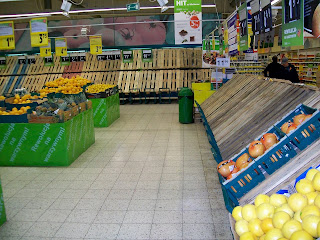
Tesco, which is supposed to be open twenty-four hours, was closing at 6PM, and there was a mad rush. Most of the produce was gone (see pictures below) and the lines were stacked. I got in one line, then moved to another. In the second line, a woman was checking out her goods and loading them into a pink backpack, but she looked awfully familiar. I could have sworn she was a student of mine from way-back when. As I walked to the subway, I passed her and blurted out, "Do I know you? Were you a student of mine?" She looked at me and a smile broke across her face. She was in fact, a former student of mine, and apparently I live on the same street as her parents. Small world, small city.
I carpeted the area, buying an unbelievable amount of eggs, but not finding a single stalk of asparagus! In a last resort, I went to the one open produce stall at a usual farmer's market, and pointedly asked if the proprietor had asparagus. And indeed he had! For the cost of 20zl per bunch. The asparagus (as I was to find out) was less than the freshest in spite the label that claimed to be the freshest. It was white asparagus, which I had never had, but I was overjoyed. The story ends well, with the hollandaise turning out OK, there being enough eggs to go around, and with me eating over half the asparagus myself (apparently the Poles are not the hugest fans of it.) The potatoes were a little over-boiled, but the poached egg and bekon combination was good enough for me. If the guests didn't like it, they didn't let it show.
Poland, Warsaw, Warszawa, Tesco, shopping, supermaket, hypermarket, empty shelves, Easter, Wielkanoc
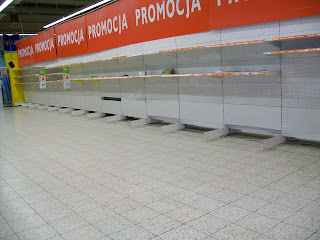
The empty shelves of Tesco.

Poland, Warsaw, Warszawa, Tesco, shopping, supermaket, hypermarket, empty shelves, Easter, Wielkanoc

Poland, Warsaw, Warszawa, Tesco, shopping, supermaket, hypermarket, empty shelves, Easter, Wielkanoc
Nothing left of the promotions.

So, while these international megastores failed to provide the essential ingredient to the Easter breakfast, a single, brave soul, who was taking advantage that his competitors were home with their families, was able to sell me some overpriced, less-than-fresh asparagus. (The asparagus really tied the whole meal together.) Easter was saved, but not by whom you would think. It's just another one of those Easter miracles.

Oh, and we ate a crapload of eggs.

Saturday, March 13, 2010

Recipe: Szarlotka (Apple Cake)

A traditional layered apple cake that serves quite well as a coffee cake.

OK, but before we get started, I'm going to go off on the lack of vanilla extract here. In my baking, I usually use gallons of the stuff; here, they have aromat waniliowy (basically the scent of vanilla) and vanilla sugar. Vanilla sugar works best because it actually has the vanilla flavor; the other stuff just makes your cake/cookies/pastry smell like vanilla (kind of stupid, right?) I haven't been able to procure some vanilla beans, so I'm stuck using packets of vanilla sugar.
Also, they do a lot of measuring by weight here (in metric too. Double whammy.) So I just converted it to English units.

1 lb of flour plus a little more
5.5 ounces of powdered sugar
5 egg yolks (or just use the whole egg.)
5.5 ounces of oil
5 ounces of butter
1 tsp baking powder (optional)
Dash of almond oil (optional)

3.5 lb of apples

Preheat oven to 350º F.
Combine everything but the apples and mix into a dough. Wrap the dough up and put it in the fridge to chill for at least an hour. Peel and shred the apples (mashing them into apple sauce also works.) Take about 2/3 the dough and spread evenly into a greased cake pan or baking dish. Spread the apples evenly on top of the dough.
Next, there are two ways of adding the remaining 1/3 of the dough. You can just spread it on and shove that sucker in the oven; or, shred the dough with a grated and sprinkle it atop the apples. Regardless of how you apply the top layer of dough, stick it in the oven for 30-45 minutes. After it's done, you can dust it with powdered sugar.

Recipe: Piegusek (Poppy Seed Cake)

This is a cake recipe that I've acquired recently and it is quite delicious. So, go and bake it. It's a little scant on baking instructions (it comes straight out a family's collection of recipes) but I'll try my best to guide it.

1 cup poppy seeds
1 cup flour
1 teaspoon baking powder
1 cup oil
1 cup egg yolks (keep egg whites.)
1 cup sugar
Confectioner's sugar

Preheat oven to 350º F. In a bowl, mix the poppy seeds with the oil; add yolks, flour, and baking soda. Knead dough. Whip the egg whites with the sugar and combine with the rest. Spread evenly in greased cake pan or baking dish, making sure that it has an even depth. Bake 30-45 minutes.

The piegusek can be cut into squares like a coffee cake and sprinkled with powdered sugar.

Monday, March 8, 2010

Jezyk/Ozorek

Recently, I attended a birthday/nameday (imieniny) gathering (it was for two different people.) It was maddeningly boring (a real marathon of dullness), but that's beside the point. The real humdinger of this event was the ozorek (beef tongue) that was served. Now, it might not be very special for many people, but in the US, beef tongue is not often served, so I was quite curious to try it.
I should note, that I—as a rule—don't eat offal of any sort (liver is especially repulsive. It's absolutely hideous in terms of texture, taste, and smell. It's the organ that filters out toxins from your body!) I was willing to try tongue on the basis that it's not an organ meat, but rather a muscle.
The ozorki were arranged on a plate with some horseradish sauce. It may be just the way that it was cooked, but they were dull brown and didn't at all look like tongues. They had a beefy taste (no surprise there) and they were very tender (imagine what a cooked tongue would have as a texture and that's what it's like.) I ate only one portion and didn't go for any more, but the experience wasn't unpleasant in any way. The horseradish sauce complimented it quite well.
The bottom line of it all is that, had no one told me that it was tongue, I would have never had known or guessed (and probably helped myself to more.) It's a food that can please even the most squeamish of eaters; just don't tell them it's a cow's tongue.

Saturday, October 24, 2009

The Traditional Polish Salad

The name of the post is actually a misnomer (but not by much. It's actually called Salatka Jarzynowa.) An extremely popular Polish salad is one that resembles a potato salad sans potatoes. It's eaten on holidays, at parties, and makes up a 'standard' dish of Polish cuisine. Canned tuna is a relatively new thing, and this recipe utilizes it well. Honestly, at first it seems a little white-trash, but it's pretty good.

The ingredients usually include:
1 can of tuna
1 can of corn
1 red pepper (diced)
1 pickle (diced)
Some minced chives
Plenty of mayonnaise
Salt and pepper to taste

Mix everything together in a bowl and serve.

There are many variations of this recipe. Some used chicken instead of tuna, others have peas or minced onion; even apple! (It's all good.) Diced, hard boiled eggs are often added as well. Add something that you think will work, and eat away.

Thursday, August 6, 2009

Recipe: Leniwe Pierogi (Lazy Dumplings)

While traditional stuffed pierogi such as pierogi ruskie and pierogi z miesem dominate Polish pierogi menus, several varieties of solid pierogi (like those more available in Slask and Czech cuisines) are still made by the bearers of tradition. Some Poles are hesitant to even classify them as pierogi (dumplings) at all, and refer to them as noodles.

This recipe comes from the mother of a student of mine, which in turn got in from her mother, and so on.

While a sweet dish, it's served for dinner.

Ingredients:
700-800 grams of cottage cheese (probably around three-four cups) (NOTE: The best cheese for this is twaróg (called quark in English, I believe.) It's like a drier form of cottage cheese.)
3 tablespoons of flour (more if needed)
2 eggs
Pinch of salt
Butter (optional)
Bread crumbs (optional)
Sugar (optional)

In two separate bowls, separate the egg whites and the yolks. Beat the whites until stiff like a meringue. Combine first four ingredients (including both egg whites and yolks) into large mixing bowl and mix thoroughly until a sticky dough has formed. Start boiling some water.
Divide the dough into two equal balls; roll balls between palms and a floured surface to form a mid-sized 'ropes' of dough about two-inches thick. Cut the ropes into pieces, maybe a half-inch thick. Place the pieces into the boiling water and cook them for three (3) minutes. Retrieve the dumplings using a slotted spoon and place on a dish.
Smother with butter; sprinkle with bread crumbs; sprinkle with sugar; serve.

The bread crumbs, sugar, and butter are optional. You may wish to serve them in a white-cheese sauce, or as traditional pierogi (or however you wish.)

There are several variations of this recipe. Some call for potatoes (use 75% of the cheese and add in 200g of cooked, mashed potatoes.) Experiment a little and see what works!

Saturday, June 13, 2009

Some Recipes for Fish

One thing about most Polish food is that it's remarkably simple. I must admit that I have a copy of Julia Child's Mastering the Art of French Cooking, and many of the recipes require pages of ingredients and numerous laborious steps to complete. Have you ever made risotto? It's step after step after step, that's why is so expensive to order.

While I have a few Polish cookbooks, I'll try not to pull recipes out (besides, I don't own the copyrights and I hate citing works.) So, these recipes come from some housewives who learned them from their mothers (or mother-inlaws.) They miss some exact measurements, but that's half the fun; you can experiment with what you want and decide what you think is good.

Here are a few recipes for herring (sledz, pronounced like "shledge"):

The first one is an incredibly simple sledz in oil, which I find is rather popular (especially for Christmas Eve Supper.)

Ingredients:
2-4 medium fillets of sledz (herring.) (Many Poles buy this from fish markets. The fillets are salted and technically edible as is.)
vegetable oil
2-3 medium onions
peppercorns and capers are also optional.

Soak fillets in water for two hours and rinse (this is if you buy the sledz in the traditional way: salted.) Cut the fish into small pieces and pack into a sizable jar. Dice onions and pack on top (add other ingredients if you wish.) Fill jar up with oil and let sit for several days (it's good up to two weeks. I'd keep it in the fridge.) And that's it!

Pretty simple, right?

The next one actually isn't a Polish recipe, it's a Russian one. It's called "Herring in a Fur Coat" and has enough cholesterol to kill a pig. I think it's also a traditional New Years food there.

Ingredients:
1-2 medium fillets of salted herring
3 medium onions
3 medium potatoes
5 eggs
4 small beets
2 large carrots
a large jar of mayonnaise

Get a good-size bowl (large enough to fit everything.) Peel and boil potatoes in salted water until cooked through (about fifteen minutes.) Boil the eggs until they are hard-boiled; boil beets until cooked through (but firm; maybe a half-hour.) Boil carrots until soft (ten minutes.) Peel eggs, potatoes, carrots, onions, and beets. Dice and fry the onions over medium heat until translucent (ten minutes.)
Get out your grater. Grate herring (if it's too hard, you can just mince it up as well) and layer the bottom of the bowl with it. Cover the herring with the onion and grate the potatoes over the onions for the third layer. Grate the egg whites over the potatoes; grate the carrots over the egg whites to form the fifth layer; grate the beets over the carrots to form the sixth. Add a good layer of mayonnaise atop the beets and top with the crumbled egg yolks. Cover and let it sit in the fridge for a few hours and let the mayo really seep down and sink in. Serve chilled.
You can mix up the layers and have multiple layers of herring or beets and whatnot. It ends up all mixed up anyway on the plate, but it's pretty good.

Monday, February 9, 2009

Polish Food: Smalec

At first description, smalec (small-lets) seems to be one of the most repulsive foods imaginable. It's bacon grease (yes, bacon grease) with seasonings and onions, and used as a spread. It is, however, quite delicious. My first encounter with it was at the Folk Gospoda restaurant. Smalec was served as an free appetizer and my gracious host, K, insisted on me trying it, "I really want you to try this. It's one of my favorites."
By the way, Folk Gospoda is a pretty cool restaurant in Warsaw. They sell beer in giant mugs and five-liter graduated cylinders, plus the food is pretty good and they have live music. The tables are all picnic tables and the decor is common with many other traditional restaurants, in that it's supposed to be like a peasant's house.
Anyway, the smalec came with a basket of bread. It sat there in the bowl, looking like a collection of gray vomit, waiting for me to try it. Regardless of how it looked, it tasted really good!!! The piggy taste of normal bacon grease was absent, and all that was left was a savory flavor that was quite enjoyable. The texture is more akin to hummus than butter or shortening like Crisco. The cholesterol content must be off the charts (i.e. don't eat this stuff every day. Crack it out only for occasions.)
NOTE: I had no alcohol when I ate this meal, but apparently smalec and beer go along together well. Next time I encounter it (as I surely will) I'll probably update this post with my most professional opinion.

Saturday, January 10, 2009

Milk Bars, Sphinx and Others

Milk bars were once the most fashionable way of dining out. They combined cheap, good food, with quick service. These days, there are not many left. Most have fallen to competitors such as Sphinx, McDonald's, and restaurants of a higher class.
Milk bars are not unlike cafeterias. The one I've visited looked very much like one. The decor is all tile, which makes it rather damp in wintertime. The food comes out immediately as your order it and you pay right there at the cash register. The cost of the entire meal was less than entrees in some places.
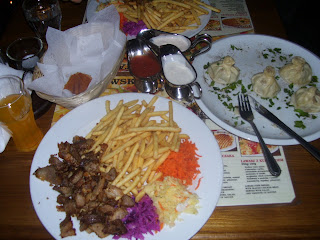
A meal at a milk bar in Krakow
A meal at a milk bar in Krakow.

Sphinx is a Polish chain similar to Applebees or TGI Fridays. It serves pseudo-Egyption food (along with other types), it's main dish being shoarma. Basically it's chopped up pork or chicken with seasoning, served with french fries, three types of sauces (spicy, mild and garlic), and some small sides of salads. (Note: most salads are not as Americans think, as in, lettuce, tomatoes, carrots. Usually it's something more like shredded carrots, coleslaw, shredded beets.) They also have steaks, burgers, and maybe burritos - I'm not sure. I can't really defend the food at Sphinx, and their bloody maries are simply terrible, but if you're just in the mood to eat something, why not? Plus, they are one of the few places that serve drinks in the half-liter sizes. Oh, and the waiters (they're always waiters) either have mullets or plucked eyebrows.

Krakow is home to two chains, "U Babci Maliny" (At Granny Raspberry's) and "Gruzinskie Chaczapuri." One serves traditional Polish food in another cafeteria-esque setting (the setting is warmer though) and the other is similar to Sphinx but serves Georgian food. Both are centered in Krakow's Old City (UBM is in a few other cities), whereas Sphinx is a national chain. UBM has large portions, cheap food, and is in a dining room with cut wooden benchs on cut-log tables. It's decorated to be a traditional peasant's farmhouse, but there's a huge warm-water aquarium in the center of the room (most likely Polish peasants only had fresh, cold-water aquariums.) The link to the page is here and it's HIGHLY suggested you visit it just for the introductory song.
The meal at the Georgian Restaurant

Wednesday, December 31, 2008

Pierogi

Pierogi are the plural of 'pieróg' (dumpling.)  In the US, we say "pierogis", which is technically incorrect because we're doubling the plural.  In Poland, one can see on the store windows ads for "chipsy."  No joke.  They're doubling the plural for chips in adding a 'y'.

Here's what I do for pierogi dough.  I make it via approximate amounts, so there are no clearly defined measurements.  Sometimes it needs a little more water, sometimes it needs a little less.  That type of thing (get the idea?)

5.000 cups of flour
Water
Two dashes of salt
Milk product, e.g. milk, yogurt, kefir (this is optional.)
1 egg (optional)

Mix all ingredients into a bowl and knead together until it forms a soft, pliable dough.  Don't make it too elastic.  Add more water to the dough until the consistency feels right.  Roll out on floured surface and use a sizable glass to cut circular pieces out.  Put filling on one side and fold over other side to form a crescent shaped dumpling.  Press edges together until they are sealed (some people dip their fingers into a cup of water and run it around the edge to create a better seal but I don't think it works that well.  It usually just gets kind of messy.)  Put uncooked pierogi into pot of boiling water and remove when floating (about five minutes.)
Can sauté afterward if desired.

See?  It's pretty vague, but that's pretty much how to make pierogi.  Fillings include mashed potatoes and cheese, saurkraut, sweet cheese, meat, anything else you'd want to stick in there.
The milk product will make the dough more fragile, but also softer.  Too much kneading will make it rather tough and bread like.

In-process pierogi.

Frying them up

Thursday, December 25, 2008

Christmas Food

Christmastime means good, hearty Polish cooking.
Polish Christmas Dinner
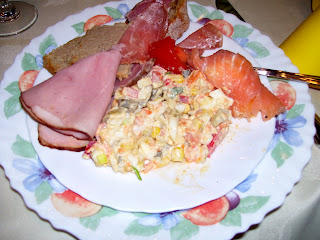
My plateful of appetizers, including: smoked salmon filled with cream cheese and herbs, a salad (kind of like a potato salad without the potatoes), cold cuts (mostly being ham and pork, but also some kindziuk, a Lithuanian cured sausage similar to salami) and bread.

As I stated before, Christmas Eve is devoid of meat and almost every dish contains at least some part fish. Barszcz and pierogi are also main features to the meal. Usually, the barszcz is served with small, pierogi-like dumplings filled with mushrooms. They're called uszka (little ears) because of the way they look. This Christmas we didn't have the uszki, just the barszcz served in glasses like a drink; although, we did have pierogi.
hard-boiled egg caviar
An appetizer I didn't have, hard-boiled egg with caviar. Usually a lemon is squeezed over it.

Herring is the most common fish in Poland. It's called Śledź (shledge) and is a staple of Polish cuisine. If it's not herring, the fish is always something similar, i.e. it's always a whitefish. In the US we think of whitefish as trash fish and mostly used for soups and stews (or making fish 'n chips.) Salmon, swordfish, tuna, trout, these are the fishes we enjoy the most. Fish with high fat content and distinct flavor. Fish that looks good on the plate, and not like some sort of maxipad that's been run under a tap for fifteen minutes.
Anyway, on Christmas Eve we had: herring in oil with onions, herring in some sort of jelly (I didn't try it), herring chopped up in a small side salad, greek-style fish (burbot was used instead of herrring.)
The coolest tradition, I think, is buying a large, live carp; taking it home and putting it in your bathtub; killing, gutting, cooking and serving it on Christmas Eve. Not very many people do that these days, but it used to be popular.
Polish Christmas Dinner
Christmas Dinner: Main Course. Pork loin, carrot salad, mashed potatoes and a salad with oranges. The sauces to the left are horseradish, beet and horseradish and a cranberry sauce.

As for drinks, we didn't have much in the way of alcohol. Two bottles on Christmas was enough for the whole holiday. The white was OK, but the red was dreadful (it was a Spanish red and tasted kind of like transmission fluid.) At both meals the main drink was Coke. Juice and water were also available. On Christmas Eve, we were served a compote made from dried fruit. It came in two versions, one was sweetened and the other was not. Both tasted kind heavily of prunes, but it was OK.

Christmas Traditions

Christmas is kind of big, so I'll cover it in a couple parts.  This year, it was not a white Christmas, but it was cold.

Christmas Eve in Poland is a bigger event than Christmas Day (in terms of traditions.)  It's a day of abstinence from eating meat, and if one is urged to attend Mass; however, not everybody does.  The main festivity of the day is a huge meal, which is mostly composed of fish dishes.  Before the meal we each took a large wafer (akin to the Host one receives in Church except they're big and square and have little pictures pressed into them) and everyone said hello to each other and wished each other health, wealth, good things, happiness, good grades in school, etc.  I mostly just stood there awkwardly and grinned while nodding.  After you wish the other person well, you exchange a small bit of your wafer (you pinch it off the other person's wafer) and each it.  Then, you move on to the next person.  After everyone has wished everyone else well, you all go around the table again.  There was a short, short reading of the Bible, and singing a carol.  I did not burst forth with a melodious rendition, but stood there and listened to verse after verse.  We sat down for the feast finally and began eating.  One curious thing I noticed, is that people here don't wait for others to sit down (or even be at the table or in the room) to begin eating.   For a place where manners are heavily enforced, I found this to be sorely lacking and quite surprising.
During the end of the meal presents were passed out.  It might just be this family, but the gifts were all anonymous and attributed to Santa "Saint Mikolaj."  I received a DVD copy of "Ogniem i Mieczem" (With Fire and Sword), which surprisingly works in my computer's DVD player (so it must be a Region 1 DVD.  I've had problems before with playing other European copies of DVDs.)  I also got a knife set in a handsome wooden case.

On nearly every corner there are Christmas trees for sale.  Most are rather small, which makes sense because most people have apartments.  We opted for one in a pot.  It's been referred to as a "Charlie Brown" tree because it lacks the heavy ornamentation that adorns all other trees.  A string of lights and a handful of bulbs bought from a nearby Tesco are sufficient.  Still, it's the largest of the family.  Other members have fake trees or ones so small they're more like saplings.  My pleas for a traditional method of getting a Choinka were rejected.  I wanted to slog into Kabaty, at night if need be, and chop down a worthy tree.  My mother recently claimed that her tree was the best of all time (a boast I had trouble believing, but that just might be my envy.)  My uncle went to a tree farm and chopped down his own tree (my aunt was not impressed with the one he chose.)    Both my mom and my uncle chopped down large trees and just took the top (an acceptable method.)  Going to a farm is not exactly the same as hunting for that perfect tree, but it's still better than buying one off the street corner.
The tree salesmen nearest to the apartment were way too overpriced.  We had to go one subway stop and got one for half the price: 40zl versus 99zl.  I had to carry the tree on the subway with the top snagging all sorts of places on ceilings (have you ever really noticed how topographical ceilings are?  One doesn't notice it until having to lug a tall object about that scraps against all surfaces under ten feet in height.

Friday, July 4, 2008

Sie essen das Essen in Essen.

Poland has a city called "Boat" (Lodz) and Germany has a city called "Food" (Essen.)
Since coming here, I've eaten more brined and cured food items than I have in my entire life and I expect to develop an ulcer soon, if not stomach cancer. Largely, it is of my own accord.  Sauerkraut (Kapusta Kiszona), pickles and sour pickles (the sour pickles are fermented much like sauerkraut) (Ogorki Conserwowe and Ogorki Kiszone) as well as cured meats like kindziuk and dried kielbasa.
As in America, there is a difference between what people eat at home and what they eat at a restaurant. While they do have pierogi, barszcz and (ugh) flaki, mostly it is eaten for special occasions.  Barszcz, a classic, is usually served at Christmas, and it's quite different from what most people think.  While it is a beet soup, it's not thick like the Russian kind.  Instead, it is (guess!) semi-fermented.  It's clear, acidic and made by doing some small fermenting with rye bread.  Flaki is supposed to be eaten in the winter and/or when you are very drunk.  It's a hearty soup made from tripe and looks like some dog just threw it up.  I don't know how it smells, but I assure you that I'm not eager to find out.
American food is commonly thought of just hot dogs and hamburgers (both of which are German.  Hamburger (Hamburg) and Frankfurter (Frankfurt)) but there is actually a lot of originality.  Take a Thanksgiving feast:  Turkey, Pumpkin pie (these types (apple, pumpkin, cherry) are not common outside North America) pecan rolls, mashed potatoes (served all around the world.)  This is good food, and you'll be hard-pressed to find someone who will object.  It has a good balance of protein, starch and veggies (usually there are brussels sprouts, salad, maybe asparagus.)  One complaint of German cooking is that it is often only protein and starch (mainly potatoes.)  Also, there are more "Asian" restaurants in the US than McDonalds', Wendys' and Burger Kings combined (upwards of 40,000 (I think.))  General Tsao's Chicken is a purely American creation.  The Chinese don't eat that shit.  Most Japanese would be appalled at our sushi and most Thai would find Pad Thai (in the words of Jon Stewart (or one of his writers)) "Bland and unfamiliar"  (Jon Stewart's America the Book:  Democracy Inaction. (rest of citation to follow.))
So, just as one has misguided thoughts of American food, so one has of Polish food.  Almost.  True, they eat a lot of pierogi and have a lot of restaurants that serve it, they aren't eating it as often as we think.  They each generic meals of potatoes, salads and meat, not prepared in any sort of way.  They eat spaghetti.  They eat pizza and drink cheap beer.  They eat cereal and granola and yogurt for breakfast.

Home made pierogi

Poland, I think, is overlooked for its food and cuisine in general.  They utilize a lot of pork, potatoes and beets (beets is often understated when listing main ingredients for Polish cuisine.)  Just like the French stick liver in everything (oh, that horrid offal), the Polish stick beets in everything (it's mostly just a side-dish.)  French fries are just as common as they are in the US.  Kielbasy (all types) are cornerstones. Dumplings and soups, soups, soups!!!  Chlodnik is a delightful yogurt, beet, cucumber and radish soup served with a sliced hard-boiled egg atop.  Perfect for a hot afternoon, as it is more refreshing than any soft drink.  Barszcz Bialy is served with a dollop of sour cream and eggs.  Zurek is warming, and all the soups are filling.  One soup I had, I don't know the name, was made with ogorki kiszone (sour pickles) and it was fucking awesome.
A mushroom soup in a bread bowl.  The bread was delicious.

I remember once, when I was in Krakow, I went to a nice restaurant.  It was my last night in Krakow and I was alone, so I thought "Why not?"  I think I had duck.  At the end, I ordered a "Swiss Coffee" thinking it would be something like a mocha; all hot and chocolately.  I was wrong.  It was black coffee and rum, and was probably the most bitter beverage I've ever had.  I found a few years later that the place was one of, if not the, nicest places in Krakow.  That explains my bill.