Tuesday, June 9, 2009

Stettin: Szczecin: Brickville

This past weekend I went to Szczecin for a three-day trip which was bound to involve a lot of opera. Now, I'm not the hugest opera fan in the world, but I was especially invited to view the premiere of Piekna Helena at Opera na Zamku (The Opera in the Castle.) More details in the next post about that.

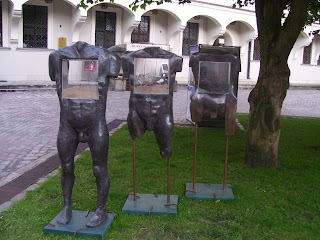
artwork szczecin pomeranian dukes castle stettin
Artwork in the castle courtyard. In each chest there is sand with progressively more trash and pollution. As there is more pollution, the body changes until it becomes less defined and more 'mechanical' in a sense.

My road to Szczecin started at 10:45 in Warszawa Centralna. I bought my ticket with minutes to spare and hurried down to the platform where the waiting train was already boarding. Rushing through the cars, I found a cabin that was somewhat open. Inside, three men sat in a haze of cigarette smoke, one with a lit cigarette in his hand, obviously ignoring the No Smoking sign on the doorway, while the other two had their hands ever-ready on their darling packs of Marlboros. I sat down but only stayed a few minutes after I couldn't take the smell and the stinging in my eyes anymore. I grabbed my luggage and hunted for a new compartment.
The next one I found was peaceful an quiet with two men. I sat down between them (apparently the opposite bench was taken by women that were absent.) A young man to my right stared straight ahead while he shifted to make himself comfortable, while the older gentleman to my left (around sixty) listened to heavy metal on a Sony discman. The conductor came along and after looking at my ticket, promptly told me that I needed to move: these train cars were going to Zielona Gora, not to Szczecin. I asked which ones were going to Szczecin and he said to go three more wagons down.
I finally came to rest in a compartment with three gentlemen (one left in Poznan, I think) and tried my best to sleep. The sun does rise early in these summer days and I only managed about two hours of broken sleep before I arrived in Szczecin Glowny. Right before we did, we passed through some of the thickest fog I have ever seen. Outside the windows was pure white that reduced visibility to zero. From the main train station there was still some fog hanging over the water.
Morning fog from Szczecin Glowny Stettin
Morning fog from Szczecin Glowny (Stettin Hauptbahnhof.)

My time in Szczecin was limited, but enjoyable. I spent a great deal of time in the Zamek Ksiazat Pomorskich w Szecinie (The Pomeranian Dukes' Castle) and the Opera na Zamku (The Opera at the Castle), which is an opera company that operates out of the castle.
On Saturday, it was the last day of Dni Kultury Ukrainskiej (Days of Ukrainian Culture) at the castle. There was a large stage set up in the main courtyard, on which traditional Ukrainian folk dances and songs were performed. I only caught the tail end, but the performers' uniforms were terrific and hilarious. Also, I'm pretty sure that some of the songs they were singing are more of the 'Pop' category, and were not traditionally sung by Ukrainian peasants while harvesting their grain. One song that was absent from the performance was the fantastic Razom Nas Bahato, Nas Ne Podolaty.
Dances of Dni Kultury Ukrainskiej

Inside the castle, within the realm of the Opera, a restaurant called "Restauracja na Kuncu", which is a play on words, since the director of the Opera's last name is Kunc. It's a bit of fine dining; a place to go for a meal or coffee before the show, but it has reasonable prices. The prices were further reduced because everyone associated with the Opera gets half-off all dishes (something the owner resents.) Thus, with my indirect association I was able to dine there with a relatively small bill. Aside from the usual fare of typical Polish food, it offers some interesting additions. One such was the Salmon Tartare, a take on steak tartare (sans egg yolk) with salmon. I had it, and it was really good! Their pierogi are serviceable, but I've certainly had better; their sauces contain a distinct amount of cumin.
Sign for the restaurant in Opera na Zamku
Sign for the restaurant in Opera na Zamku.

The clock tower at the Pomeranian Dukes Castle
The clock tower at the Pomeranian Dukes' Castle.

I was given a restaurant and shopping guide by a member of the opera, which was more entertaining than it was valuable. Inside it boasts that Szczecin is now a major destination for plastic surgery (someone told me that many Germans cross over into it, not only for plastic surgery but things like dental care as well, because it's far cheaper than in Germany.) The part on plastic surgery is as follows:

Many new and modern clinics have opened within the last couple of years and most of the staff speak very good English. A typical stay for an operation can be as short as 2 or 3 days. There are great savings! For example a breast enhancement/reduction or liposuction (fat removal) is usually 50% cheaper in Poland than in many other Northern European countries.
How wonderful. The best part of the whole guide is the part on Szczecin's history. It's an interesting little blurb that conveniently fails to mention anything about Szczecin being a German (ethnicity-wise) city for something like 700 years.

Szczecin boasts over 1000-year and turbulent history [sic]. It was the ducal seat and a member of the Hanseatic League since the 13th century. The city was one of the most powerful ports and trading centres on the Baltic Sea. During World War II, 60% of all buildings were destroyed.
And that's about it for Szczecin's history. I guess it's enough for a small pamphlet. One thing that was interesting, is the amount of German tour groups visiting the area. The most that I saw were older people, and we joked that they were coming to say, "Hey! I grew up on this street. It sure looks a lot different than it did back then."
graffiti poland
Artwork (graffiti?) on a stoop near the castle.

I should mention that Szczecin is a city dominated by brick architecture. If you love everything brick, there's plenty to see here. Marble may rule in Italy, and limestone in Western Europe, but here, brick is king. (Now, not every building is made out of brick, but all the older buildings and churches are.) Since Szczecin is known for its brickwork, many new buildings are cosmetically going with that theme and feature mainly brick facades. In some older buildings, Saint James' especially, it's easy to spot where the older brickwork has been replaced by newer bricks. I'm told the widespread use of brick is because there isn't much stone to quarry in Northern Europe. Since brick is basically dried mud and clay, which is in abundance, it found its way into being the premiere building material. They've certainly been creative with brick, and since brick goes so well with ivy, there's some ivy thrown in there as well.
St. James' Cathedral
The front facade and spire of St. James' Cathedral.
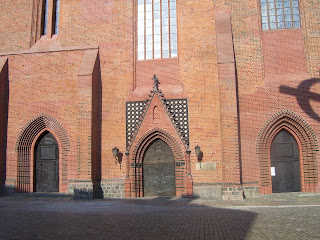
Saint James Cathedral Szczecin
The beautiful main doors to the cathedral. You can see where the old brick has been replaced by new brick.

Saint James Cathedral Stettin
An entrance on the side of the cathedral. This side was currently undergoing renovation.

Szczecin brickwork
Typical brickwork.

While Szczecin is not really that big—much smaller than I thought—it does have its share of sights. Simply wandering about will do, but they also have a path painted throughout the city that goes by all the major sites. I more of ambled about, but it's impossible not to cross this path multiple times.
I was able to catch part of a fashion show at the central mall, Galaxy, and meander through the nearby Park Zeromskiego. There, it's a stroll to the banks of the Oder River. They were actually dredging the river, so we were able to see some huge backhoe dig up the mud and silt and deposit it in a barge (the barge with the backhoe was German flagged, while the accompanying barge was flew the Polish flag.) Actually, it was a very interesting process and attracted a small crowd.
Dredging the Oder River.

A few things I left unseen, one was the interior of the St. James' Cathedral and I dearly love climbing the spires (which I was unable to do.) When we went, there was a Mass, so we were not allowed in as tourists. There were the sort collection of museums that I didn't have a chance to peruse, but I'm sure I will if I go back. It may seem rather lame that I mainly dined at na Koncu, but remember, I'm on a budget here; I'll take half-off wherever I can get it.
I was also forced to deal with the frequent crap out of my digital camera. It's a junky point-and-shoot, but it usually gets the job done; however, recently it's decided to freeze when I least want it to and to refuse turning on randomly even if the batteries are fine. While my main camera, my Canon Elan 7ne is working well, it's a film camera so unless I scan my pictures (slides; I usually shoot on slide film), I can't upload them to here.

A great place to catch lunch is at Milk Bar Turysta. Jam-packed during the rush, it's worth it. Cheap with good food and large portions, it beats out most other places. I had a wonderful bowl of chlodnik, which was perfect to cool me down in the hot afternoon.
milk bar meal stettin
My meal at the milk bar.

When I left, I took the 11:15PM train back to Warsaw. This one didn't split up and I shared the cabin with two girls and a guy with acne scars so bad he looked like he had been burned with wax. He left (in Poznan also, I think) and was replaced by another girl later on in the trip. The seats smelled like dank sweat and we were near the bathroom, so we got that wonderful waft of shit and piss that hasn't been cleaned up since Stalin died. I got more sleep this time, but it was still cramped and the bathroom was revolting (piss all over the floor.) They seriously need to update these trains.

Three days, sun and rain, not bad.

Thursday, June 4, 2009

Two Score

Twenty years ago, it all began to come apart for communist Eastern Bloc; and it all started in Poland.

They've come far, and they have a ways to go, but they don't show any signs of slowing down. Let's cheer 'em all on.


Addendum:
Most Poles I know were quite happy and marked this occasion; although not all did. One, M from Lodz, was in mourning. M isn't really old enough to remember the Communist Era, but for some reason he longs to be back in that oppressive environment. He voted for the Communists in the last election (he despises both Tusk and the Kaczynski twins) and I never really understood why. I think it's just some sort of counter-culture thing (he also hates shopping malls and the people in them. Well, so do I.)
Oh, and I fucking hate communism.

Wednesday, June 3, 2009

Stereotypes Are a Real Time Saver

Hey, why not use stereotypes?

Let's just admit it, we all carry around stereotypes. The Jews are all rich, the Americans are all fat, and the Poles are all stupid thieves. (I only say stupid because of the plethora of Polish jokes in the US. Here's one: How do you sink a Polish submarine? —Knock on the door.)
The Poles are known throughout Europe, Germany in particular, to be thieves. The German retailing giant, MediaMarkt, even released a commercial about it for the 2006 World Cup (one of many, most playing off stereotypes of nationalities.) It's actually pretty funny.


The basic gist of it, is three Poles thank the three German salesmen, saying that they have products for once in the world, "The prices are deep, like the Polish soul." After the hugs, the salesmen remark how decent Poles are, only to realize their pants are missing.
It's funny, but many Poles got really pissed off at this; they don't like jokes taken at their expense.

Is drinking the national sport of Poland? No, but it is the national sport of Russia (something like 48% of all adult Russian men die alcohol-related deaths.) The birthplace of vodka, which Poland defends more vehemently than its own borders, doesn't have shit on typical anglo-american college students (I'm not saying that with pride either.)
The Polish defense of vodka is actually quite interesting. They claim that Cîroc isn't really vodka since it's made from grapes, and they're making a big stink about this. Now that Poland is in the EU, and the EU is notorious for it's bureaucracy, they want clear definitions!

It's pretty much the consensus amongst the younger women here, that New York City is the definitive America and that all women who live there live lives exactly like Sex and the City. Many have professed dreams of moving to Manhattan for a year to do just that. I tried to tell them about how expensive it is to live in Manhattan and that the lives that the crew of SAC live are actually not very viable, but I was hushed, and told how that since it's on TV, it's not only possible, but common.

Work Day

There's this dziadek in the lab who is probably around eighty-years old. He's this wizened little fellow and hobbles along on crutches and almost always wears a bathrobe. The thing is, is that his desk isn't conveniently on the lab floor like some others, but up a flight of stairs on a platform overlooking the whole lab. He sits there, occasionally getting up to walk to his coat on the hanger, or to go someplace else. He's apparently designing some fire extinguisher that utilizes atomized water particles at high speeds. He's usually the last to leave. One time, he actually started to make conversation with me as I was leaving. As you should know, I'm not exactly the most proficient speaker of Polish, so I ashamedly said so. His English is rough, but at least he understood my small bits of Polish.

We finally got the laser to work somewhat. The instructions are all in English, so I'm usually the one reading and deciphering them. We still can't control it by the computer, only manually, but tomorrow a faculty member from the Physics Dept. should come and teach us how (he's the one who originally used it ten years ago, so he may be a bit rusty on the operating procedures.)

I'm getting more used to the formal 'Pan.' It brings back memories of my teaching Martyna, Martyna and Tosia (read here) where they all referred to me as such. There are periods where pan isn't used: K doesn't use it with me (when he does speak to me in Polish, he uses the informal 'ty', which is what I prefer.) There are no women here, so 'Pani' is completely off the table.
An interesting thing about Polish genders, is that usually they have two nouns (feminine and masculine) for one profession or occupation, i.e. student and studentka both mean student, just one is female. 'Profesor' is not one of these nouns, and referring to a female professor as "Pani Profesorka" would probably be an insult or diminutive. The correct form, according to my Polish professor (Whom I address as Szanowny Panie Profesorze) is simply "Pani Profesor."

Saturday, May 30, 2009

Polonia Reborn

It's been centuries since Poland used to flex its muscle and was the one calling the shots. The Polish-Lithuanian Commonwealth was one of the largest, most powerful states in Europe until its decline and eventual dismemberment. These days, Poland may not have the sway or the brawn they once had, but they're starting to re-grow their balls (militarily and economically.)
It's not secret that Poland wants a battery of Patriot missiles (see here) and its military has been active in both Iraq and Afghanistan while undergoing a modernization (as is the rest of the old Eastern Bloc.) Last summer's war in Georgia put Poland and the Baltic States on edge, and Poland quickly agreed to station the interceptor missiles.
Poland watched Georgia closely, many felt that they might be next. I don't think that most Poles cared who was right or wrong (Russia or Georgia) or who attacked whom first, but they were stressed that it happened at all. Some thought Georgia was abandoned by its allies (the US most of all) because they (the US) didn't send in troops. I tried to argue how this would have made things worse, and that the US backed up Georgia politically and gave them a crapload of aid, but they still thought that the US pussied out. In fact, they mostly like the idea of the Patriot missile battery and the interceptors because it would station US troops on Polish soil; if Russia did invade, US troops would be in harm's way and Washington would be forced to help.

Inter-Slavic relations and their regard for one another are for another post. These types of topics usually hit raw nerves all around (just make a pro-Stalin statement to any Pole and you'll probably find yourself locked in hand-to-hand combat. Make any sort of statement that could remotely be construed as negative about anything in Russia's past history or current situation and actions, and you'll dealing with a very angry person.)

Anyway, Poland's shock-therapy with their economy went much better than the rest of the former communist states. Even though there was a massive flood of workers to the rest of the EU after they joined in 2004, many of them are returning. Poland is undergoing a bit of a boom (two good things Poland had going for it, it didn't have any oil and it didn't have large financial institutions.) Dell moved their factory from Ireland (which was pretty new) to Poland, and many other companies are doing so as well. GM is even licensing the production of cars at the venerable FSO; although, I'm not sure how long GM will be around to continue doing so. One thing is that Poland was forced to sell off the Gdansk shipyards, and that's a bit of a bitch to swallow (the Gdansk shipyards were Solidarity's old stomping grounds.) Here's more on that subject.
Should Poland grow to an economic powerhouse, it would have leverage (as others do in the form of sanctions.) Twenty years into the Rzeczpospolita (half of what was the People's Republic of Poland), Poland is still emerging. We'll anxiously see what happens. (First, we have to get rid of those pesky visa requirements to enter the US.)

Thursday, May 28, 2009

Polish Newsletter From A While Ago

Back in 2005 my German teacher, knowing that I had been learning some Polish, sent me the Polish Studies Newsletter (he was at a loss to why he had received it.) It's not a Polish source (i.e. doesn't come from Poland, it's from the US), but it seems to claim the representation of Polish culture and thought in America. You can read the full text here. What is (somewhat) surprising is the amount venom (anti-semitism, homophobia, and racism.) While these are all fairly common in Poland (and the US)—and don't say they aren't—I've never really seen it in such blatant anger. Sure, M admitted he didn't like Jews and that Israel was a made up country he wished to see gone (in Lodz, they use the Star of David for the K in LKS. Graffiti is often in the form of "Jebac LKS!" See my post on Widzew Lodz.) and G remarked that the Jews run the world, but they didn't really go as far as this:
There are only 4,000 Jews serving in our armed forces. Why so few, when the facts reveal that there are more than 4,000 Jewish Americans serving in the Jewish Army? Why the discrepancy?...Katrina proved that Black people look to the government too much because they do not know how to ‘take care;’ of themselves. Our country shall not survive if we subsidize those who want to be dependent on the government.
I can only assume the "Jewish Army" is the IDF.

Then this thing goes on to make wild claims like "Hitler begged the Poles to relent on Danzig and join him on an attack of Ukraine. Polish Jews directed Beck to take a hard line against Hitler." (One note here, the city of Gdynia was built because the city of Gdansk (Danzig) was in German territory.) This guy is obviously off his rocker. First off, Hitler's begging days had been over for quite some time, and have Poland join in an attack on Ukraine? Not only did Hitler not even consider that, but also Ukraine is on the other side of Poland from Germany. Germany would have had to go through Poland anyway (which is what they did) or go through Hungary and Rumania (hey! They did that also!) And why is this guy suggesting that Poland surrender its only Baltic coast so Germany can have a corridor to Prussia? (remember? Gdansk and Königsberg were Germany back then.) And why the hell is this guy taking the German side anyway?
Here is another jewel of insight and reason:
Simon Wiesenthal passed away 9/24. He invented the ‘Holocaust’ card and played it like a violin. His legacy is the Simon Wiesenthal Center in Los Angles. The Center specializes in bashing Poles and politicizing the Holocaust.
Hey, some people might think I'm just quote mining (I actually kind of am) but you can read the whole thing yourself. I must stress that this is not actually from Poland, but rather a (presumed) Polish-American. Whoever wrote this (it doesn't say, but the editor is some guy named Albin Wozniak), is kind of an embarrassment. He does, however, provide some useful links and resources for Polish grants and such.

My last thought: that guy's kind of a nutcase.

Wednesday, May 27, 2009

Formalities

Polish, like many languages, has a formal and informal way of addressing people. For speakers like me, it's a real bitch. It's not just the added conjugations that you have to worry about, it's to whom you're talking. OK, so people your age and lower you can address informally (ty), and those older or of higher position you use the formal (pan.) But in my internship I noticed that the professors would address the students using the formal sense, which kind of confounded me. But what is more, is what if I wanted to talk to an elderly person whom I know quite well (let's say, for sake of an example, a mother-in-law)? Would I use the formal or informal? I know it seems silly to those who are used to it, and it's perfectly normal ("Just use the formal with strangers." they say) but I think it's just a bunch of bunk.

Tuesday, May 26, 2009

First Day

Yesterday was my first day at my internship. Incredibly nervous, I took the metro to Politechnika and followed the stream of college-aged youth towards the campus. A stranger to the layout (I'd never actually really explored this part of Warsaw) I tried to find my way to the correct building in this urban campus.

The campus reminded me of Karlsruhe, where all the buildings were closed clumped together without quads of any sort. Those of us that hail from land grant universities are used to large distances between buildings and epic journeys to get from class to class.

Inside the building, the corridors were cramped and almost claustrophobic. It didn't help that they were hot and jam-packed full of students loudly chatting with each other. It felt almost like high school again.

I found the professor's office, knocked on the door and hoped he would be in. He answered the door and invited me inside. He was rather tall, older than his official picture on the website, and reminded me of my photography teacher from high school (I'm looking at you, Galen.)

We talked for a short bit, and then he called in the fellow under whom I would working, called K. K took me to the huge lab, which housed many different-sized wind tunnels and an under-construction water tunnel. One of the wind tunnels, made entirely out of wood, suffered a small design flaw (its exit opened up at too steep an angle), and K said I might have to redesign it.

After showing me the lab floor he brought me up to where my 'office' would be. I was given an unused desk in a room with another guy (of whose job here I'm not entirely certain.) There was a bunch of paper crap and a derelict computer which they cleared away. K brought me up a pretty new computer with Linux and this other guy asked me about his printer, which apparently suffered from too little memory. K was displeased about the amount of dust on my desk, so he rang in a call to somewhere and shortly two cleaning ladies carrying pails came in to make sure that the desk was dust-free. At first I lacked a mouse, and the first mouse that K gave me was simply a plastic shell (I have since gotten a newer, better mouse.)

I have a phone on my desk, which I never use. It once rang so I picked it up to hear a conversation in progress (think of Jimmy Stewart in Mr. Hobbs Takes a Vacation.) I was told it's a communal line and that all the phones in the lab are linked as such.

K took me to the mensa to get some lunch. (For those of you who do not know what a mensa is, it's like a dining common (similar to a cafeteria.)) A frumpy-looking woman served up the food (lunch ladies are the same everywhere.) It was surprisingly expensive; fourteen zloty for mashed potatoes, kotlety drobione (mid-way between a meatball and a hamburger), a cranberry compote with a health serving of cranberries at the bottom of the cup, and a small salad (not the freshest.) It was actually a good-sized serving of food, and it wasn't bad. A nearby kebab, however, sells at about 5zl.

Back in the lab, K and I set about trying to figure out how to use this laser they have. The laser is about ten-years old, but they've just recently got it. After about three hours, we finally got it to function (not fully. One of the beams (it's a two-beamed laser) still isn't firing at all and we don't know why. We even cracked the case open to look at the motherfucker; we two guys aimlessly poking around to make sure all the electrical connections are secured didn't fix anything.) It's pretty cool, and they have these glasses that shield you from the laser; when you put them on, the laser point disappears.

Day one down, day two in progress.

Sunday, May 24, 2009

Cinematics

I haven't seen tons of Polish movies, but I like to think I've seen the ones that count (and then some.) The classics like Pan Tadeusz, Ziemia Obiecana, Ogniem i Mieczem, and Katyn are must-sees to anyone wanting to learn more about Polish culture.


Pan Tadeusz is often called the national novel (or, more accurately, epic poem) of Poland (although, it takes place in Lithuania.) To be clear, I've never actually read the work or any translation of it, but what I have seen of it reminds me of Dante's masterpiece, The Divine Comedy (probably because of the rhyming.) Anyway, I downloaded and saw the 1999 film with several Poles, and afterwards remarked, "Hmmm, that really wasn't worth the time and effort to download, was it?" This made one of the Poles incredibly angry, blasting me for not caring about Polish history or suffering (this is how passionate Poles are about this poem and how much they resent the partitions of Poland.)

But, c'mon, this movie isn't really that great and the story actually kind of sucks. The production quality, especially the 'battle' scenes, is below that of Gettysburg (a movie I actually like very much) but that's really not the issue. The titular character, Pan Taduesz, is not even the main character and only demands about 25% of the plot line. He's also not really the most admirable or interesting character, and his most notable achievement is being able to nail some older noblewoman (who is actually kind of a conniving bitch) while trying to woo her niece. Pan Tadeusz is actually the most bland character in the whole production and the entire storyline would have suffered little if he was removed entirely (they could have stitched it together.) Mostly the film centers on the squabbling of two minor szlachta families, the Soplicas and the Horeszkos, over some ruin of a castle. What it does do is underline how the bickering of the szlachta allowed Poland to carved up and eventually erased from the map. The biggest kick in the balls is that the film abruptly ends when the movie starts getting interesting (when they start fighting the Russians instead of bitching at each other over family honor.) I've been told that the film doesn't do justice to the poem, and that it's really a great read (something I won't bring into dispute.)

The other films, like Ziemia Obiecana (The Promised Land), which portrays the hopes and ravages of the industrial revolution, are remarkably better. Katyn is the best of the lot, with Ogniem i Mieczem (With Fire and Sword) falling more towards Pan Tadeusz, but not really falling to that depth (it's a good watch.) Katyn is the heart-wrenching, and reminds me of the great, Schindler's List. Most of these films are downers and all the main characters end up "bummed out."

On the other side, I have actually seen Mala Wielka Milosc (Little Great Love.) A Polish-American RomCom, it proves that the Polish can make comedies almost as insipid as the Americans (they have a ways to go to reach the suckitude of Freddy Got Fingered and EuroTrip. For a good romantic comedy, watch High Fidelity.) A predictable storyline about an up-and-coming big shot lawyer who learns about responsibility, humility, and love from a down-to-earth Polish girl by knocking her up. He loses all his possessions, but in reality gains everything meaningful in life. He also has a fat, stupid sidekick bestfriend.


This summer, I hereby pledge to go on a Polish movie binge and see what I can so I can really put my ax to the grindstone. I can't wait to see the promising crapfest of To Nie Tak Jak Myslisz, Kotku (It's not what you think, Dear. (Kotku is actually the diminutive of kot (cat) but in this sense it can be translated as 'dear.')) Also, the even more terrible-looking Idealny Facet Dla Mojej Dziewczyny (The Ideal Guy for My Girl) is something I can't wait to sink my teeth into (some naked chick was on the posters; that pretty much says it all.)

The film, Wojna Polsko-Ruska (The Russo-Polish War), looks to be rather good. I've heard that the book is quite good and one of the best Polish books of the past decade. We shall see.

Saturday, May 23, 2009

Flight Over

Well, I'm back in Poland. I was greeted by overhanging clouds and a steady rain.

There's no real need for me to talk about my trip in great detail, but I will anyway.
It all started when E gave me a ride to Logan Airport. The day was searing hot; not a cloud in the sky or even a breeze of any sort. He had his little Garmin GPS set to avoid toll roads, so I got a pleasant tour of previously-unseen Mass, guided by some mechanical voice with a British accent (it even used the word 'roundabout' instead of "rotary.')

E dropped me off at Terminal A (NWA used to fly out of Terminal E, but ever since they were bought out by Delta they've switched to Terminal A.) I checked in with almost no problems (my first bag was two pounds over weight. I had to rummage in it and take out my tiny tripod and my paperback copy of Gödel, Escher, Bach. It ended up being two pounds under the limit. Great success. The automatic check-in machine was also kind of a piece of shit.)
My flight was at 7:05 PM, and I arrived at the airport at four, so I had some waiting to do. No problem, I watched some lectures from my online class and sat it out by the window, watching the ground crew load the A330. At 5:30 there came an announcement that our aircraft had a large mechanical problem (something to do with the nose landing gear.) They estimated that it would be fixed by 10 PM and that we'd fly out at 11:15. A short while later they announced again that the mechanical problem could not be fixed tonight and that they were flying in another plane from Minneapolis, which would be here around ten, and that we'd fly out at 11:15. I began to somewhat panic, since I was originally due to arrive in Amsterdam at 8:00 AM local time, and fly out at 9:45. Now they were saying that we'd arrive in Amsterdam no earlier than 10:00.
A long line formed at the gate desk, and stood up and joined at the back, intent on finding out when I was able to get a connection. While waiting in line I chatted to some fellow travelers and got my voucher NWA passed out. One was $25 off my next flight, another was 2,000 frequent flyer miles, and another was for a $10 voucher that could be used to buy some food in the terminal. I waited in line for about ninety minutes. When I was about two people away to speaking to representative, one of them got on the speaker and announced that Delta was not running the connections, on KLM-Royal Dutch Airlines was doing that, and Delta had no idea what we would have to do. We were directed to speak to KLM representatives when we arrived in Amsterdam.
Seeing as I was being picked up at Chopin Airport, I tried to find a way to contact them saying I wasn't arriving. Internet at Logan costs like $8 per day, and I wasn't about to do that. Strangely, I could access rottentomatoes.com, avclub.com, hulu.com, and YouTube (I was only able to watch one video, the rest had 'errors.') A guy sitting next to me inquired about the internet, and I replied that these must have been a fluke. He let me use his Blackberry Storm (it's kind of crappy, really. Not really a good GUI) to send an SMS.
I used my voucher at the nearby Game On bar. They were out of food (the kitchen had just closed), but they had to Sox game on. I got a pint of Samuel Adams Summer Ale (a fine pint indeed) and watched the Sox for a bit.
The plane arrived and we finally boarded. I got an aisle seat, sitting next to an older woman. I read a bit from a complimentary Wall Street Journal (Mexico's economy has taken a hit to the balls) and waited for take off. We sat on the plane for a bit, and the pilot announced that a circuit breaker had blown on a minor system and shouldn't cause much of a delay. It took a short bit, but we were airborne a little after 12:45 AM—over six hours later than our supposed take off.
I slept through most of the flight, missing breakfast. We landed in Amsterdam around 1:00 PM. The pilot had gone up to 39,000 feet and gunned the engines, cutting the seven-hour trip down to six. Going through customs was fairly easy, but the line was exceedingly long. The customs guard was smiley and pleasant. After seeing my old student visa for Germany, he asked, "You were in Germany? Sprechen Sie Deutsch?" I replied, "Ein bisschen." He gave a nod, "Ein bisschen."
It's strange, these days almost all check in is automatic. You get your tickets from a machine, and now they have these automatic transfer machines. I scanned the barcode from my original boarding pass and it printed me out a new one. My new flight was at 2:50, landing in Warsaw at 4:50. I could only hope that my luggage would follow me there.
Follow me it did. It was some of the first luggage to be unloaded onto the carousel. I had unfortunately gotten a middle seat between some fat old guy, who had terrible breath and smelled like an alcoholic, and some middle-aged woman. Halfway through the flight, the guy got up, and I suspected he went to the bathroom. He left a carryon bag under the seat, but he never returned. Either he had to take a massive hour-long shit, or he just moved to another open seat.
No one was there to greet me at the terminal, so I headed straight out to the bus stop. I was exceedingly fortunate when my bus arrived just as I walked up. On the way to the apartment there was a girl and her mother going for the First Communion (they got on at a different stop.) The little girl was dressed elegantly all in white, with a white wreath of flowers on her head and white gloves, white shoes, and a white purse (even a little fur-lined white shawl.) It was quite a clash and contrast of the prim and proper against the background of the everyday riffraff (like last summer at the wedding in Sosnowiec, where there was a a grubby beggar and her children on the church steps while everyone stood in their Sunday best in line to congratulate the bride and groom.) I really wanted to take a picture, but I didn't want them to get angry (I wasn't sure how the mother would react.)

Well, that's pretty much how I got here. Jet lag still eats at me, but I'll manage.